Thank you very much for visiting Gunter's Space Page. I hope that this site is useful and informative for you.
If you appreciate the information provided on this site, please consider supporting my work by making a simple and secure donation via PayPal. Please help to run the website and keep everything free of charge. Thank you very much.
Hughes / Boeing: HS-702 / BSS-702, HS-GEM / BSS-GEM (Geomobile)

BSS-702 (Anik F2) [Boeing BSS]
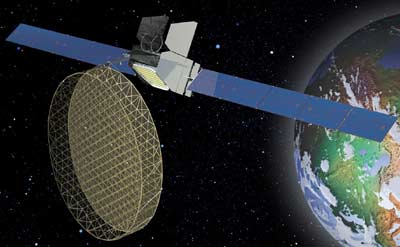
BSS-GEM (Thuraya 2) [Boeing BSS]
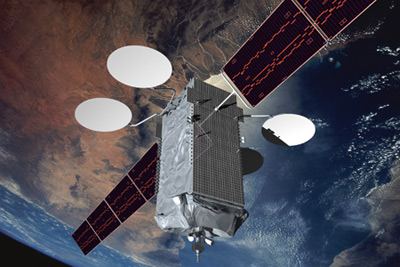
BSS-702MP (Intelsat 21) [Boeing BSS]
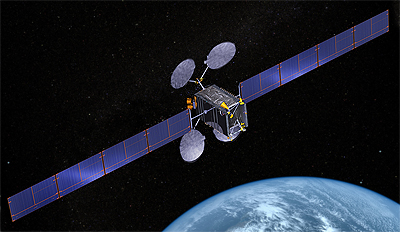
BSS-702SP (ABS 3A) [Boeing]
Evolved from the popular, proven 601 and 601HP (high-power) spacecraft, the body-stabilized Boeing 702 is the world leader in capacity, performance and cost-efficiency.
The Boeing 702 design is directly responsive to what customers said they wanted in a communications satellite, beginning with lower cost and including the high reliability for which the company is renowned. For maximum customer value and producibility at minimum total cost, the Boeing 702 offers a broad spectrum of modularity. A primary example is payload/bus integration. After the payload is tailored to customer specifications, the payload module mounts to the common bus module at only four locations and with only six electrical connectors. This design simplicity confers major advantages. First, nonrecurring program costs are reduced, because the bus does not need to be changed for every payload, and payloads can be freely tailored without affecting the bus. Second, the design permits significantly faster parallel bus and payload processing. This leads to the third advantage: a short production schedule.
Further efficiency derives from the 702's advanced xenon ion propulsion system (XIPS), which was pioneered by BSS and is produced today by Boeing Electron Dynamic Devices, Inc. XIPS is 10 times more efficient than conventional liquid fuel systems. Four 25-cm thrusters provide economical stationkeeping, needing only 5 kg of fuel per year – a fraction of what bipropellant or arcjet systems consume. Using XIPS for final orbit insertion conserves even more mass as compared to using an on-board liquid apogee engine. Customers can apply the weight savings to substantially increase the revenue-generating payload at small marginal cost, to prolong service life, or to change to a less expensive launch vehicle (when cost is based on satellite mass). For even more versatility, the Boeing 702 also incorporates a bipropellant propulsion system, which can lift the satellite into final orbit after separation from the launch vehicle.
Innovation extends to the Boeing 702 power systems as well. The Boeing 702 offers a range of power up to 18 kW. Dual and triple-junction gallium arsenide solar cells enable such high power levels. Spectrolab, Inc. a Boeing subsidiary, developed the cells.
The first version of the 702 used solar arrays with concentrators. These concentrators tended to early fogging, as due to an inherent design flaw the outgassing of the solar cells was higher than expected. This fogging lead to much reduced lifetime. The flaw was corrected in later versions with higher power triple-junction gallium arsenide solar cells.
The Boeing 702 separates the bus and payload thermal environments and substantially enlarged the heat radiators to achieve a cooler, more stable thermal environment for both bus and payload. This increases unit reliability over service life. Deployable radiators use flexible heat pipes, which increase packageable radiator area. Further thermal control occurs through passive primary rejection via heat pipes.
The baseline Boeing 702 is compatible with several launch vehicles. These include the Delta IV, Atlas V, Ariane 5, Proton, and Sea Launch.
The Boeing GEO-Mobile satellite system features a 12.25-meter deployable antenna, and onboard digital signal processing and beamforming. It is a mobile-communications-supporting satellite system that integrates a Boeing geosynchronous-orbit satellite with a ground segment and a user terminal segment.
In 1997, Hughes Space and Communications Company, now Boeing Satellite Systems, received a nearly $1 billion contract for Thuraya, a system consisting of two GEO-Mobile satellites that will serve the Middle East, North and Central Africa, Europe, Central Asia and the Indian subcontinent. It is the largest satellite communications project in the region and will serve nearly 1.8 billion people. The first Thuraya satellite was launched in October 2000. Thuraya-2 was launched in June 2003.
In 2008 Boeing introduced the midsized 702MP. The MP is only slight less heavy than the HP—about 12,500 lb.—but has mid-range power at 6-12 kW, although Intelsat has launched it with hosted payloads. Intelsat remains the MP’s only customer.
In 2012, Boeing introduced the 702SP, the smallest member of the family, which has been under development for the past two years and completes a geostationary series with power ranges of 3-18 kW. With the 702SP, Boeing is offering a van-sized spacecraft—15 ft. high and 7 ft. wide—that weighs 4,000 lb. at launch. Unlike its two larger family members, it will use an all-electric station-keeping propulsion system. The MP and HP rely on a mixed use of chemical propellants and electric propulsion.
Failures:
Following failures of 702 models have occured:
- Anik F1: - degradation of solar concentrators - long term power loss
- Galaxy 11: - degradation of solar concentrators - long term power loss
- PAS 1R: - degradation of solar concentrators - long term power loss
- Thuraya 1: - degradation of solar concentrators - long term power loss
- XM 1: - degradation of solar concentrators - long term power loss
- XM 2: - degradation of solar concentrators - long term power loss
| Satellite | Ordered | Date | Launcher | Weight (kg) | Remarks | ||
|---|---|---|---|---|---|---|---|
| Launch | BOL | ||||||
| HS-702 / BSS-702 (with concentrator arrays) | |||||||
| Anik F1 | 1998 | 21.11.2000 | Ariane-44L H10-3 | 4711 | 2950 | ||
| Galaxy 11 | 1997 | 22.12.1999 | Ariane-44L H10-3 | 4488 | 2775 | ||
| PAS 1R (ex Galaxy 14) → Intelsat 1R | 1997 | 16.11.2000 | Ariane-5G | 4758 | 2990 | ||
| XM 1 (XM Roll) | 1998 | 08.05.2001 | Zenit-3SL (1) | 4682 | 2950 | ||
| XM 2 (XM Rock) | 1998 | 18.03.2001 | Zenit-3SL (1) | 4682 | 2950 | ||
| HS-702 / BSS-702 (redesigned) → BSS-702HP | |||||||
| Anik F2 | 2000 | 18.07.2004 | Ariane-5G+ | 5950 | 3805 | ||
| DirecTV 10 → AT&T T-10 | 2004 | 07.07.2007 | Proton-M Briz-M (Ph.2) | 5893 | 3700 | ||
| DirecTV 11 → AT&T T-11 | 2004 | 19.03.2008 | Zenit-3SL (2) | 5923 | 3700 | ||
| DirecTV 12 → AT&T T-13 | 2004 | 29.12.2009 | Proton-M Briz-M (Ph.2) | 6060 | 3700 | ||
| Galaxy 3C (ex PAS 9 ex Galaxy 13) | 1997 | 15.06.2002 | Zenit-3SL (1) | 4810 | 2835 | ||
| Inmarsat-5 F1 (GX 1) | 2010 | 08.12.2013 | Proton-M Briz-M (Ph.3) | 6070 | 3750 | ||
| Inmarsat-5 F2 (GX 2) | 2010 | 01.02.2015 | Proton-M Briz-M (Ph.3) | 6070 | 3750 | ||
| Inmarsat-5 F3 (GX 3) | 2010 | 28.08.2015 | Proton-M Briz-M (Ph.3) | 6070 | 3750 | ||
| Inmarsat-5 F4 (GX 4) | 2013 | 15.05.2017 | Falcon-9 v1.2(ex) | 6086 | 3750 | ||
| NSS 8 | 2001 | 30.01.2007 | F | Zenit-3SL (2) | 5920 | 3800 | |
| SES 9 | 2012 | 04.03.2016 | Falcon-9 v1.2 | 5330 | |||
| Spaceway 1 | 1999 | 26.04.2005 | Zenit-3SL (2) | 6080 | 3832 | ||
| Spaceway 2 | 1999 | 16.11.2005 | Ariane-5ECA | 6116 | 3832 | ||
| Spaceway 3 | 1999 | 14.08.2007 | Ariane-5ECA | 6116 | 3832 | ||
| ViaSat 2 | 2013 | 01.06.2017 | Ariane-5ECA | 6418 | |||
| WGS 1 (USA 195) | 2002 | 11.10.2007 | Atlas-5(421)¹ | 5987 | |||
| WGS 2 (USA 204) | 2002 | 04.04.2009 | Atlas-5(421)¹ | 5987 | |||
| WGS 3 (USA 211) | 2002 | 06.12.2009 | Delta-4M+(5,4) | 5987 | |||
| WGS 4 (USA 233) | 2006 | 20.01.2012 | Delta-4M+(5,4) | ||||
| WGS 5 (USA 243) | 2006 | 25.05.2013 | Delta-4M+(5,4) | ||||
| WGS 6 (USA 244) | 2007 | 08.08.2013 | Delta-4M+(5,4) | ||||
| WGS 7 (USA 263) | 2011 | 24.07.2015 | Delta-4M+(5,4) (upg.) | ||||
| WGS 8 (USA 272) | 2011 | 07.12.2016 | Delta-4M+(5,4) (upg.) | ||||
| WGS 9 (USA 275) | 2012 | 19.03.2017 | Delta-4M+(5,4) (upg.) | ||||
| WGS 10 (USA 291) | 2012 | 16.03.2019 | Delta-4M+(5,4) (upg.) | ||||
| XM 3 (XM Rhythm) | 01.03.2005 | Zenit-3SL (2) | 4703 | ||||
| XM 4 (XM Blues) | 2003 | 30.10.2006 | Zenit-3SL (2) | 5193 | |||
| BSS-702B → BSS-702MP | |||||||
| AMOS 17 | 2016 | 06.08.2019 | Falcon-9 v1.2 (Block 5)(ex) | 6500 | |||
| GiSAT 1 | 2016 | 2019 | Falcon-9 v1.2 (Block 5) | ~6000 | cancelled | ||
| Horizons 3e | 2013 | 25.09.2018 | Ariane-5ECA | 6441 | |||
| Intelsat 21 | 2009 | 19.08.2012 | Zenit-3SL (2) | 5984 | |||
| Intelsat 22 | 2009 | 25.03.2012 | Proton-M Briz-M (Ph.3) | 6199 | |||
| Intelsat 27 | 2010 | 01.02.2013 | F | Zenit-3SL (2) | 6241 | failed | |
| Intelsat 29e | 2012 | 27.01.2016 | Ariane-5ECA | 6552 | |||
| Intelsat 33e | 2013 | 24.08.2016 | Ariane-5ECA | 6600 | |||
| Intelsat 35e | 2014 | 05.07.2017 | Falcon-9 v1.2(ex) | 6761 | |||
| Intelsat 37e | 2013 | 29.09.2017 | Ariane-5ECA | 6438 | |||
| Intelsat TBD | 2013 | ||||||
| JCSat 18 / Kacific 1 | 2017 | 17.12.2019 | Falcon-9 v1.2 (Block 5) | 6956 | |||
| Nusantara 5 (Nusantara Lima) | 2022 | 2024 | Falcon-9 v1.2 (Block 5) | ||||
| Silkwave 1 (NYBBSat 1) | 2015 | 202x | ~6000 | ||||
| BSS-702MP+ | |||||||
| ViaSat 3.1 (ViaSat 3 Americas) | 2016 | 01.05.2023 | Falcon-Heavy (Block 5)(ex) | 6418 | |||
| ViaSat 3.2 (ViaSat 3 EMEA) | 2016 | 2025 | Atlas-5(551) | ~6400 | |||
| ViaSat 3.3 (ViaSat 3 APAC) | 2019 | 2024 | ~6400 | ||||
| ViaSat 3.4 | 202x | ~6000 | Option | ||||
| HS-GEM / BSS-GEM (GeoMobile) (with concentrator arrays) | |||||||
| APMT 1 | 1998 | cancelled | CZ-3B | ||||
| APMT 2 | 1998 | cancelled | CZ-3B | ||||
| Thuraya 1 | 1997 | 21.10.2000 | Zenit-3SL (1) | 5108 | 3200 | ||
| HS-GEM / BSS-GEM / BSS-702HP-GEM (GeoMobile) (redesigned) | |||||||
| MEXSAT 1 (Centenario) | 2010 | 16.05.2015 | F | Proton-M Briz-M (Ph.4) | 5325 | ||
| MEXSAT 2 (Morelos 3) | 2010 | 02.10.2015 | Atlas-5(421)¹ | 5325 | |||
| MSV SA | 2006 | cancelled | 5400 | 3200 | bus converted to BSS-702HP | ||
| SkyTerra 1 (ex MSV 1) | 2006 | 14.11.2010 | Proton-M Briz-M (Ph.2) | 5390 | 3200 | ||
| SkyTerra 2 (ex MSV 2) | 2006 | Proton-M Briz-M (Ph.3) | 5400 | 3200 | rebuilt as MEXSAT 2 | ||
| Thuraya 2 | 1997 | 10.06.2003 | Zenit-3SL (2) | 5177 | 3200 | ||
| Thuraya 3 | 2002 | 15.01.2008 | Zenit-3SL (1) | 5250 | 3200 | ||
| BSS-702SP | |||||||
| ABS 2A (MongolSat 1) | 2012 | 15.06.2016 | Falcon-9 v1.2 | ||||
| ABS 3A | 2012 | 02.03.2015 | Falcon-9 v1.1(ex) | 1954 | |||
| ABS 8 | 2015 | cancelled | Falcon-9 v1.2 (Block 5) | cancelled | |||
| Eutelsat 115 West B (ex SATMEX 7) | 2012 | 02.03.2015 | Falcon-9 v1.1(ex) | 2205 | |||
| Eutelsat 117 West B (ex SATMEX 9) | 2012 | 15.06.2016 | Falcon-9 v1.2 | 1963 | |||
| SES 15 | 2015 | 18.05.2017 | Soyuz-ST-A Fregat-M | 2302 | |||
| SES 20 | 2020 | 04.10.2022 | Atlas-5(531) | ~1500 | ~1500 | ||
| SES 21 | 2020 | 04.10.2022 | Atlas-5(531) | ~1700 | ~1700 | ||
| (US Gov 1) | 2013 | ||||||
| (US Gov 2) | 2013 | ||||||
| (US Gov 3) | 2013 | ||||||
| BSS-702X | |||||||
| WGS 11 | 2019 | 2024 | Vulcan Centaur VC2L | ||||
| WGS 12 | 2024 | 202x | |||||