Thank you very much for visiting Gunter's Space Page. I hope that this site is useful and informative for you.
If you appreciate the information provided on this site, please consider supporting my work by making a simple and secure donation via PayPal. Please help to run the website and keep everything free of charge. Thank you very much.
SNAP 1
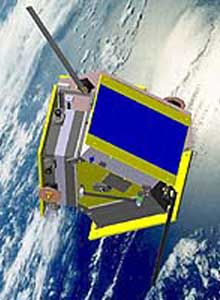
SNAP 1 [SSTL]
SNAP-1 (Surrey Nanosatellite Applications Platform) was designed and built as a research mission by a joint academic-commercial team at the Surrey Space Centre and SSTL - funded entirely by SSTL. The objective of SNAP-1 is to demonstrate in orbit the capabilities of advanced, highly integrated nanosatellites and their use as autonomous robots for observing orbiting space vehicles.
In addition to the machine vision payload, SNAP-1 carries a miniature propulsion system, the size of a pencil, using butane. This is currently being used to manoeuvre the nanosatellite to rendezvous with the Chinese Tsinghua 1 microsatellite. Also on-board this tiny spacecraft are other miniature systems: a momentum wheel and magnetorquers for 3-axis attitude control; a GPS receiver for autonomous orbit determination; a 220 MHz 'StrongARM' 1100 on-board computer for housekeeping and high level vision functions; and an S-band communications system.
| Nation: | UK |
|---|---|
| Type / Application: | Technology |
| Operator: | SSTL |
| Contractors: | SSTL |
| Equipment: | |
| Configuration: | SNAP bus |
| Propulsion: | |
| Power: | Solar cells, batteries |
| Lifetime: | |
| Mass: | 6 kg |
| Orbit: | 683 km × 706 km, 98.13° |
| Satellite | COSPAR | Date | LS | Launch Vehicle | Remarks | |
|---|---|---|---|---|---|---|
| SNAP 1 | 2000-033C | 28.06.2000 | Pl LC-132/1 | Kosmos-3M | with Nadezhda 6, Tsinghua 1 |
References:
- SSTL: SNAP-1