Thank you very much for visiting Gunter's Space Page. I hope that this site is useful and informative for you.
If you appreciate the information provided on this site, please consider supporting my work by making a simple and secure donation via PayPal. Please help to run the website and keep everything free of charge. Thank you very much.
GSat 2
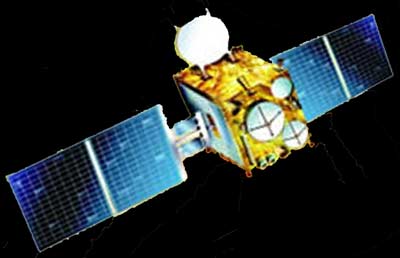
GSat 2 [ISRO]
GSAT-2 is a 2000 kg class experimental communications satellite onboard the second developmental test flight of India's Geosynchronous Satellite Launch Vehicle, GSLV Mk.1(2). The satellite carries four C-band transponders, two Ku-band transponders and a Mobile Satellite Service (MSS) payload operating in S-band and C-band for forward link and return link respectively.
Besides the communication payloads, GSAT-2 carries four piggyback experimental payloads:
- Total Radiation Dose Monitor (TRDM) to compare the estimated radiation doses inside the satellite with the directly measured radiation doses using a Radiation Sensitive Field Effect Transistor (RADFET)
- Surface Charge Monitor (SCM) to indicate the state of the charging environment in the vicinity of the satellite
- Solar X-ray Spectrometer (SOXS) to study the solar flare emission in 4 keV.- 10 MeV energy range using state of the art semiconductor devices and Phoswich Scintillation Detector
- Coherent Radio Beacon Experiment (CRABEX) to investigate the spatial structure, dynamic and temporal variations of Ionosphere and several aspects of equatorial electrodynamics
| Nation: | India |
|---|---|
| Type / Application: | Experimental Communication |
| Operator: | Insat |
| Contractors: | ISRO |
| Equipment: | 4 C-band transponders, 2 Ku-band transponders, MSS payload (S-band forward, C-band return), TRDM, SCM, SOXS, CRABEX |
| Configuration: | I-2K (I-2000) Bus |
| Propulsion: | LAM |
| Power: | 2 deployable solar arrays, batteries |
| Lifetime: | |
| Mass: | 1825 kg |
| Orbit: | GEO |
| Satellite | COSPAR | Date | LS | Launch Vehicle | Remarks | |
|---|---|---|---|---|---|---|
| GSat 2 | 2003-018A | 08.05.2003 | Sr FLP | GSLV Mk.1(2) |
References:
- ISRO: GSAT-2
Further GSat missions:
- GSat 1 [I-2K]
- GSat 2 [I-2K]
- GSat 3 (EduSat) [I-2K]
- GSat 4 (HealthSat) [I-2K]
- GSat 5 [I-2K]
- GSat 5P [I-2K]
- GSat 6, 6A [I-2K]
- GSat 7 [I-2K]
- GSat 7A [I-2K]
- GSat 8 [I-3K]
- GSat 9 (South Asian Satellite) [I-2K]
- GSat 10 [I-3K]
- GSat 11 [I-6K]
- GSat 12, 12R (CMS 01) [I-1K]
- GSat 14 [I-2K]
- GSat 15 [I-3K]
- GSat 16 [I-3K]
- GSat 17 [I-3K]
- GSat 18 [I-3K]
- GSat 19 [I-3K]
- GSat 20 (GSat N2, CMS 03) [I-3K]
- GSat 22 [I-3K]
- GSat 23 [I-3K]
- GSat 24 (CMS 02) [I-3K]
- GSat 29 [I-3K]
- GSat 30 [I-3K]
- GSat 31 [I-2K]
- GSat 32 [I-8K]