Thank you very much for visiting Gunter's Space Page. I hope that this site is useful and informative for you.
If you appreciate the information provided on this site, please consider supporting my work by making a simple and secure donation via PayPal. Please help to run the website and keep everything free of charge. Thank you very much.
Galaxy 19
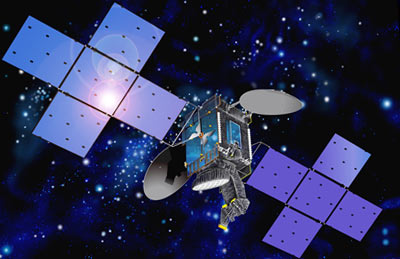
Galaxy 19 [SS/Loral]
Space Systems/Loral (SS/L) announced in November 2004 that, pursuant to the contract entered into in March 2004, it has reached agreement with Intelsat LLC for the design of Intelsat Americas-9 (IA-9), a high-power, C- and Ku-band satellite that will provide service to North America, Central America and the Caribbean. SS/L has been authorized to proceed on the manufacture of IA-9 immediately. Intelsat changed the name of the Intelsat Americas satellite to Galaxy 19 effective to 1 February 2007.
The satellite's hybrid C- and Ku-band communications payload carries a total of 52 operating transponders, selectable among 62 discrete frequencies, providing a total of 1,944 MHz of downlink capacity. Coverage areas are provided by fixed C- and Ku-band antennas, in addition to an adjustable Ku-band spot beam that can be positioned anywhere on the earth's surface visible from the satellite's orbital position. The satellite is designed to operate from any of Intelsat's orbital locations from 77 degrees West longitude to 129 degrees West longitude. The satellite is based on SS/L's space-proven SSL-1300 geostationary satellite platform, which has a long and proven record of reliable operation.
The satellite is scheduled for delivery to Intelsat in 2007 and has a design life of 13 years. Galaxy-19 will cover North America and replace Galaxy 25.
| Nation: | USA |
|---|---|
| Type / Application: | Communication |
| Operator: | Intelsat |
| Contractors: | Space Systems/Loral (SS/L) |
| Equipment: | 24 C- and 28 Ku-band communications payload (total of 44 operating transponders) |
| Configuration: | SSL-1300 |
| Propulsion: | R-4D-11 |
| Power: | 2 deployable solar arrays, batteries |
| Lifetime: | 13 years (20 years planned) |
| Mass: | 4692 kg |
| Orbit: | GEO |
| Satellite | COSPAR | Date | LS | Launch Vehicle | Remarks | |
|---|---|---|---|---|---|---|
| Galaxy 19 (ex Intelsat Americas 9, IA 9) | 2008-045A | 24.09.2008 | SL | Zenit-3SL (2) |
References:
- Space Systems/Loral: Galaxy 19