Thank you very much for visiting Gunter's Space Page. I hope that this site is useful and informative for you.
If you appreciate the information provided on this site, please consider supporting my work by making a simple and secure donation via PayPal. Please help to run the website and keep everything free of charge. Thank you very much.
Starscan (P86-2)
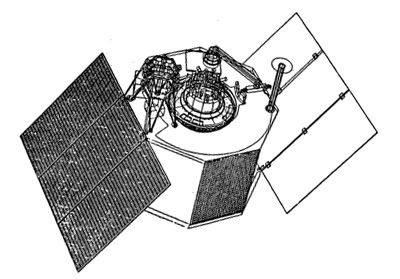
Starscan [Ball Aerospace]
Starscan (P86-2) was an experimental satellite to detect and identify radioactive material in orbit. After the discovery, that the SolarMax astronomy satellite's gamma ray instrument suffered from interference from radioactive debris originating from the soviet US-A (RORSAT) type Kosmos 1176 satellite, this project was initiated to study this radioactive material in orbit.
The satellite was to be built on a octagonal prism shaped structure with thwo deployable solar arrays. Ball Aerospace was awarded in 1987 a $43 million contract to develop the orbital insertion stage and to integrate the science instruments.
Two primary instruments and a source deployment system were planned for the StarScan satellite with secondary instruments to be added:
- ANDAS (Advanced Neutron Detection and Analysis System) by the Los Alamos National Laboratory. This instrument is used for the broadband detection of neutrons. It consists of two hexagonal scintillator asemblies configured as Anger-cameras. The top consisted of a boron-loaded plastic scintillator bonded to a 4 mm 6Li-glass scintillator. The bottom assembly consisted of a 10 cm boron-loaded plastic scintillator with 0.7 cm bismuth germinate (BGO) crystals bonded tot the top and the bottom. Each assembly was viewed by an array of 19 3 inch PMT's. Both assemblies are shielded on the sides with 2 mm 6Li-glass or 0.7 cm thick BGO crystals.
- ANGAS (Advanced Nuclear Gamma-ray Analysis System) by Lockheed. This was an high resolution gamma-ray spectrometer which incorporates a rotational aperture synthesis imaging system. The primary sensor array comprised 19 large, cryogenically cooled, high purity n-type Ge-detectors sensitive to gamma-rays from about 20 keV to 10 MeV. These sensors were surrounded by a massive NaI(Tl) shield that provided Compton and external background suppression and served independently as a large omni-directional spectrometer with medium resolution. Holes drilled through the top of the shield defined a 15° FWHM field-of-view for the Ge sensors. An angular resolution of about 1.2° FWHM was obtained by the imaging system.
- SDS (Source Deployment System) is a retractable radioactive source package that is deployed by a coilable longeron boom mechanism. The source package provides calibration signals to the ANGAS and ANDAS instruments. The boom mechanism is designed to position the source package two to five meters above the ANGAS and ANDAS. The lightweight source package, located on the tip of the boom, is designed to have a relative rotation with respect to ANGAS of up to 5 rpm about an axis that is coaligned with the ANGAS look direction and is centered on the ANGAS detection array.
Launch was planned for a 1991 lift-off from Vandenberg AFB on a Titan-2(23)G rocket with Star-37FM kick stage to put the satellite into 546 km sun-synchronous circular orbit inclined at 97.5 degrees to the equatorial plane. The mission was cancelled in 1988 due to budgetary cutbacks.
| Nation: | USA |
|---|---|
| Type / Application: | Experimental |
| Operator: | DARPA, USAF STP (Space Test Program) |
| Contractors: | Ball Aerospace |
| Equipment: | ANDAS, ANGAS, SDS |
| Configuration: | |
| Propulsion: | |
| Power: | 2 deployable solar arrays, batteries |
| Lifetime: | 1 year (min.) |
| Mass: | 3038 kg |
| Orbit: | 546 km × 546 km, 97.5° |
| Satellite | COSPAR | Date | LS | Launch Vehicle | Remarks | |
|---|---|---|---|---|---|---|
| Starscan (P86-2) | - | cancelled | Va SLC-4W | Titan-2(23)G [Star-37FM] |
References:
- Wiley J. Larson: Doctor of Engineering Internship Experience at Ball Aerospace Systems Division, Boulder, Colorado, April 1988