Thank you very much for visiting Gunter's Space Page. I hope that this site is useful and informative for you.
If you appreciate the information provided on this site, please consider supporting my work by making a simple and secure donation via PayPal. Please help to run the website and keep everything free of charge. Thank you very much.
Sirio 1, 2
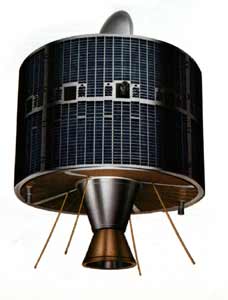
Sirio 1
Sirio 1 (Satellite Italiano ricerca industriale orientato) was primarily a geostationary communications satellite. It included experiments measuring the local plasma and field environment and the flux of low-energy cosmic rays.
The satellite was launched on a Delta-2313 and was located at 15 deg w longitude.
The Sirio-2 geostationary spacecraft carried two independent payloads:
- an S-band multichannel transponder for meteorological data dissemination ('MDD') in Africa, and
- an laser detection/time-tag/retroreflector assembly to permit atomic clock synchronization over intercontinental distances (laser synchronization from stationary orbit - 'LASSO').
The cylindrically shaped spacecraft measured 144 cm in diameter and 240 cm in length including the apogee boost motor. The primary structural members are equipment platforms and a central thrust cone carrying conventional housekeeping electronics in addition to payloads. Attitude, orbit and spin rate control were performed using a hydrazine propulsion system including four thrusters. The spin rate would have been maintained at 90 rpm throughout the two-year nominal lifetime. A mechanically despun antenna relayed S-band telemetry (meteorological and housekeeping), while a traditional omnidirectional turnstile system supported VHF ranging and telecommands, as well as housekeeping telemetry in transfer orbit and as backup geostationary orbit.
Sirio-2 was lost in a Ariane-1 launch failure in 1982.
| Nation: | Italy |
|---|---|
| Type / Application: | Communication |
| Operator: | |
| Contractors: | Compagnia Nazionale Satelliti per Telecommunicaziono SpA |
| Equipment: | ? |
| Configuration: | |
| Propulsion: | ? |
| Power: | Solar cells, batteries |
| Lifetime: | 2 years |
| Mass: | |
| Orbit: | GEO |
| Satellite | COSPAR | Date | LS | Launch Vehicle | Remarks | |
|---|---|---|---|---|---|---|
| Sirio 1 | 1977-080A | 25.08.1977 | CC LC-17B | Delta-2313 | ||
| Sirio 2 | 1982-F06 | 09.09.1982 | Ko ELA-1 | F | Ariane-1 | with MARECS B |
References:
- Donald Martin, Paul Anderson, Lucy Bartamian: The History of Satellites – Chapter 1: Experimental Satellites, p.30-32