Thank you very much for visiting Gunter's Space Page. I hope that this site is useful and informative for you.
If you appreciate the information provided on this site, please consider supporting my work by making a simple and secure donation via PayPal. Please help to run the website and keep everything free of charge. Thank you very much.
ROCSAT 1 (Chunghua 1) / FORMOSAT 1
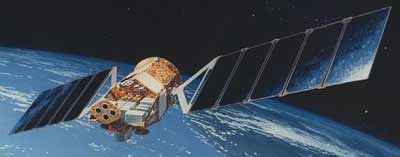
ROCSAT 1 [NSPO]
The mission objective of ROCSAT-1 (Republic of China Satellite 1) is to develop, launch, and operate a low earth orbit satellite, and to conduct three scientific and technology experiments in the areas of ocean color imaging, space telecommunication, and solar-terrestrial physics.
The ROCSAT-1 spacecraft was developed jointly by TRW with a jointed team of TRW and NSPO engineers. ROCSAT-1 is a three-axis stabilized satellite. It weights 402 kg and is hexahedron in shape with the width of 1.1 m and the height of 2.1m. The satellite orbits the earth in a circular orbit at altitude of 600 km and an inclination of 35 degrees.
The three on-board payload instruments are the Ocean Color Imager (OCI) the Experimental Communication Payload (ECP), and the Ionospheric Plasma and Electrodynamics Instrument (IPEI). The payload data and the spacecraft data are transmitted together in S-band link to the ground stations.
Lockheed Martin's Athena-1 successfully launched the satellite from Cape Canaveral, Florida, to its final orbit on January 27, 1999. Following the initial check of the system, the satellite has been commanded to the Science Mode since February 1999. The satellite's performances have been fine.
ROCSAT 1 was renamed FORMOSAT 1 in December 2004.
| Nation: | Taiwan (Republic of China) |
|---|---|
| Type / Application: | Earth observation |
| Operator: | NSPO |
| Contractors: | TRW |
| Equipment: | OCI, ECP, IPEI |
| Configuration: | T200A |
| Propulsion: | |
| Power: | 2 deployable solar arrays, batteries |
| Lifetime: | |
| Mass: | 402 kg |
| Orbit: | 588 km × 601 km, 35.0° |
| Satellite | COSPAR | Date | LS | Launch Vehicle | Remarks | |
|---|---|---|---|---|---|---|
| ROCSAT 1 (Chunghua 1) → FORMOSAT 1 | 1999-002A | 27.01.1999 | CC SLC-46 | Athena-1 |