Thank you very much for visiting Gunter's Space Page. I hope that this site is useful and informative for you.
If you appreciate the information provided on this site, please consider supporting my work by making a simple and secure donation via PayPal. Please help to run the website and keep everything free of charge. Thank you very much.
RAX 1, 2
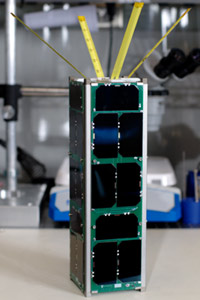 RAX [UMich] |
 RAX 2 [UMich] |
RAX (Radio Aurora Explorer) is a student-built nanosatellite for ionospheric research. It is built on a triple CubeSat structure.
The RAX will measure the energy flow in the ionosphere, the highest part of Earth's atmosphere where solar radiation turns regular atoms into charged particles.
RAX is a Ground-to-Space Bistatic Radar Experiment. The RAX satellite will act as a receiver that will pick up signals from a ground radar transmitter. These radar pulses will reflect off disturbances, or space weather phenomena, in the ionosphere.
RAX 1 was launched in 2010 as a piggy-back payload on a Minotaur-4 HAPS launch vehicle. It suffered from an anomaly on the solar panels, which resulted in degradation of power generation until, after several months, RAX-1 was unable to generate power. This anomaly ultimately resulted in the premature end of the mission. Despite this early end, the RAX-1 mission still made great strides in CubeSat design, and was able to execute bistatic radar measurements that had never before been performed with a CubeSat. All other subsystems also performed well.
The team was applying the lessons learned from RAX-1 to the design of a second flight unit, RAX-2, which was launched on a Delta-7920-10C through the NASA Educational Launch of Nanosatellites (ELaNa-3) program in October 2011.
| Nation: | USA |
|---|---|
| Type / Application: | Ionospheric research |
| Operator: | SRI International, University of Michigan |
| Contractors: | SRI International, University of Michigan, Pumpkin, Inc. (bus) |
| Equipment: | |
| Configuration: | CubeSat (3U) |
| Propulsion: | None |
| Power: | Solar cells, batteries |
| Lifetime: | |
| Mass: | 3 kg |
| Orbit: | 641 km × 652 km, 72° |
| Satellite | COSPAR | Date | LS | Launch Vehicle | Remarks | |
|---|---|---|---|---|---|---|
| RAX 1 (USA 218) | 2010-062B | 20.11.2010 | Kd LP-1 | Minotaur-4 HAPS | with STPSat 2, FASTRAC 1, FASTRAC 2, FalconSat 5, FASTSat-HSV 01, O/OREOS, NanoSail-D2, Ballast A, Ballast B | |
| RAX 2 | 2011-061D | 28.10.2011 | Va SLC-2W | Delta-7920-10C | with NPP, DICE 1, DICE 2, AubieSat 1, M-Cubed/COVE, E1P U2 |
References:
- University of Michigan: RAX website