Thank you very much for visiting Gunter's Space Page. I hope that this site is useful and informative for you.
If you appreciate the information provided on this site, please consider supporting my work by making a simple and secure donation via PayPal. Please help to run the website and keep everything free of charge. Thank you very much.
Radarsat 1
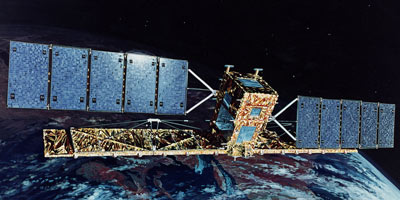
Radarsat 1 [Ball]
Radarsat 1, a Canadian-led international program and a major part of the overall Canadian Space Agency (CSA) program, is Canada's first remote-sensing satellite.
Since its 4 November 1995 launch into an 832-km sun-synchronous, dawn/dusk orbit, Radarsat has been delivering C-Band SAR imagery to the CSA and numerous commercial customers worldwide. The images are used for locating and identifying ice in the Arctic Ocean to aid in navigation; monitoring offshore oil and gas explosions and oil slicks; and acquiring remote sensing data for the management of agriculture and updating the Canadian geological map.
Ball Aerospace supported Spar Aerospace Limited, the prime contractor, by providing the spacecraft bus and assisting in the development of the mission ground station software and operations planning.
Radarsat 1 was disabled by an technological anomaly on 29 March 2013, which ended the mission after more than 17 years.
| Nation: | Canada |
|---|---|
| Type / Application: | Earth observation (Radar) |
| Operator: | CSA |
| Contractors: | Spar Aerospace (Prime), Ball Aerospace (Bus) |
| Equipment: | C-Band SAR |
| Configuration: | BCP-4000 |
| Propulsion: | ? |
| Power: | 2 deployable solar arrays, batteries |
| Lifetime: | 5 years (planned); 17 years (achieved) |
| Mass: | 2750 kg |
| Orbit: | 783 km × 787 km, 98.6° |
| Satellite | COSPAR | Date | LS | Launch Vehicle | Remarks | |
|---|---|---|---|---|---|---|
| Radarsat 1 | 1995-059A | 04.11.1995 | Va SLC-2W | Delta-7920-10 | with Surfsat 1 |
References:
- Ball Aerospace Website
- Radarsat 1
- Radarsat 2
- Radarsat-2 Continuity Mission
- Radarsat Constellation 1, 2, 3 (RCM 1, 2, 3)
- CHORUS-C 1
- CHORUS-X 1