Thank you very much for visiting Gunter's Space Page. I hope that this site is useful and informative for you.
If you appreciate the information provided on this site, please consider supporting my work by making a simple and secure donation via PayPal. Please help to run the website and keep everything free of charge. Thank you very much.
OrbView 1 (MicroLab 1)
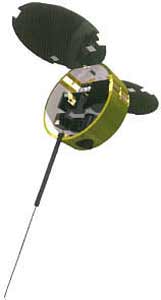
OrbView 1 [OrbImage]
Launched on 3 April 1995, OrbView-1 provides the world's first broad-area cloud-to-cloud lightning data.
OrbView-1's payload consists of two sensors:
- an Optical Transient Detector (OTD) provided by NASA's Marshall Space Flight Center, and
- an atmospheric monitoring instrument (Navstar/MET) sponsored by the National Science Foundation and the University Consortium for Atmospheric Research.
The OTD sensor maps atmospheric lighting strikes and has provided NASA with information important to the understanding of severe weather patterns. The GPS/MET sensor has proven that the signals from the GPS satellite constellation used for precision navigation can also be used to provide important atmospheric data. The success of the GPS/MET sensor has further validated the concept of using space-based sensors to improve worldwide weather prediction.
The OrbView-1 program is the result of a unique government-industry partnership between ORBIMAGE and NASA. Under this arrangement, NASA provided the OTD sensor for use on OrbView-1 and ORBIMAGE agreed to conduct an initial six-month experiment of the sensor. NASA's cost for data under this program over the past five years has totaled approximately $7.2 million.
| Nation: | USA |
|---|---|
| Type / Application: | Earth observation |
| Operator: | OrbImage (for NASA) |
| Contractors: | Orbital Sciences Corporation (OSC) |
| Equipment: | OTD (Optical Transient Detector), GPS/MET |
| Configuration: | MicroStar (double) |
| Propulsion: | ? |
| Power: | 2 deployable solar arrays, batteries |
| Lifetime: | |
| Mass: | 68 kg |
| Orbit: | 733 km × 749 km, 69.99° SSO |
| Satellite | COSPAR | Date | LS | Launch Vehicle | Remarks | |
|---|---|---|---|---|---|---|
| OrbView 1 (Microlab 1) | 1995-017C | 03.04.1995 | Va, L-1011, RW30/12 | Pegasus-H | with Orbcomm FM1, FM2 |
References:
- Orbital Science Corporation: Orbital's MicroLab Satellite
- OrbImage: Welcome to the MicroLab Program