Thank you very much for visiting Gunter's Space Page. I hope that this site is useful and informative for you.
If you appreciate the information provided on this site, please consider supporting my work by making a simple and secure donation via PayPal. Please help to run the website and keep everything free of charge. Thank you very much.
Mars Science Laboratory (MSL, Curiosity)

MSL (cruise configuration) [NASA]

MSL sky crane [NASA]
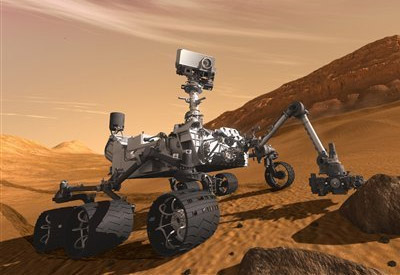
MSL rover [NASA]
MSL (Mars Science Laboratory) is a NASA rover, which was launched on 26 November 2011 and successufully landed on 6 July 2012. It is three times as heavy as the MERs that landed in 2004, it carries more advanced and elaborate scientific instrument suite than any other mission to Mars.
The spacecraft design for Mars Science Laboratory consists of:
- Cruise Stage: Configuration for travel between Earth & Mars.
- Entry, Descent, & Landing System: Configuration for entry into the martian atmosphere. Includes the aeroshell (the heatshield and backshell), the parachute, and a "sky crane" lander structure.
- Rover: A wheeled vehicle with science instruments for discoveries on the martian surface.
The spacecraft design for the Mars Science Laboratory mission is based largely on the successful twin Viking landers sent to Mars in the 1970s. The rover design is based on the Mars Exploration Rovers, which landed on Mars in early 2004. The planned system for entry, descent, and landing is entirely new. Like Viking, Pathfinder and the Mars Exploration Rovers, Mars Science Laboratory will be slowed by a large parachute. As the spacecraft loses speed, rockets will fire again, controlling the spacecraft's descent until the rover separates from its final delivery system, the sky crane. Like a large crane on Earth, the sky crane touchdown system will lower the rover to a "soft landing" - wheels down - on the surface of Mars, ready to begin its mission.
The Rover will be powered by a nuclear RTG power source instead of solar cells.
Science instruments are state-of-the-art tools for acquiring information about the geology, atmosphere, environmental conditions, and potential biosignatures on Mars. Mars Science Laboratory is being designed to carry:
Cameras
- Mast Camera (MastCam)
- Mars Hand Lens Imager (MAHLI)
- Mars Descent Imager (MARDI)
Spectrometers
- Alpha Particle X-Ray Spectrometer (APXS)
- Chemistry & Camera (ChemCam)
- Chemistry & Mineralogy X-Ray Diffraction/X-Ray Fluorescence Instrument (CheMin)
- Sample Analysis at Mars Instrument Suite with Gas Chromatograph, Mass Spectrometer, and Tunable Laser Spectrometer (SAM)
Radiation Detectors
- Radiation Assessment Detector (RAD)
- Dynamic of Albedo Neutrons (DAN)
Environmental Sensors
- Rover Environmental Monitoring Station (REMS)
The spacecraft has a launch weight 3839 kg consisting of the 899 kg rover, the 2401 kg EDL System (Aeroshell and fueled descent stage), and the 539 kg fueled cruise stage.
In June 2006 an Atlas-5(541)¹ launch vehicle was selected. In December 2008 it was announced, that MSL would be delayed by two years to 2011. In May 2009, the MSL rover received the name Curiosity.
| Nation: | USA |
|---|---|
| Type / Application: | Mars rover |
| Operator: | NASA |
| Contractors: | |
| Equipment: | see above |
| Configuration: | |
| Propulsion: | 8 × MR-80B (skycrane) |
| Power: | Solar cells (cruise stage); RTG (rover) |
| Lifetime: | 1 year cruise, 2 years prime mission, still active |
| Mass: | 3839 kg (launch); 899 kg (rover) |
| Orbit: | Heliocentric |
| Satellite | COSPAR | Date | LS | Launch Vehicle | Remarks | |
|---|---|---|---|---|---|---|
| Mars Science Laboratory (MSL, Curiosity) | 2011-070A | 26.11.2011 | CC LC-41 | Atlas-5(541)¹ |