Thank you very much for visiting Gunter's Space Page. I hope that this site is useful and informative for you.
If you appreciate the information provided on this site, please consider supporting my work by making a simple and secure donation via PayPal. Please help to run the website and keep everything free of charge. Thank you very much.
MAP (WMAP, MIDEX 2, Wilkinson, Explorer 80)
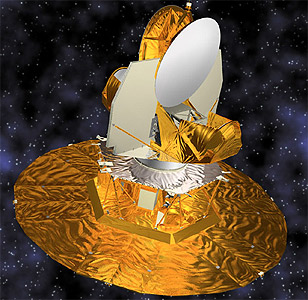
MAP (MIDEX 2) [NASA]
MAP (Microwave Anisotrophy Probe) is a follow up mission to COBE, which detected the anisotophy of the microwave background radiation. It has one instrument, which consists of a set of passively cooled microwave radiometers with 1.4 × 1.6 meter diameter primary gregorian reflectors to provide the desired angular resolution. The instrument has five frequency bands from 22 to 90 GHz to facilitate separation of galactic foreground signals from the cosmic background radiation.
MAP uses differential measuring, i.e.it measures the temperature difference between two points in the sky rather than measuring absolute temperatures. An orbit about the Sun-Earth L2 libration point provides for a very stable thermal environment and near 100 percent observing efficiency since the Sun, Earth, and Moon are always behind the instruments field of view.
It was launched in a highly excentric phasing orbit, at the fourth apogee it made a lunar fly-by and moved to a L-2 Sun-Earth Lagrangian orbit.
MAP was re-christened Wilkinson Microwave Anisotropy Probe (WMAP) in February 2003.
In October 2010, the WMAP spacecraft was derelict in a heliocentric graveyard orbit after completing 9 years of operations.
| Nation: | USA |
|---|---|
| Type / Application: | Research (Cosmology) |
| Operator: | NASA |
| Contractors: | NASA Goddard Space Flight Center, Swales Aerospace |
| Equipment: | 2 passively cooled microwave radiometers |
| Configuration: | Rapid Core Spacecraft |
| Propulsion: | ? |
| Power: | Solar cells, batteries |
| Lifetime: | |
| Mass: | 840 kg (72 kg |
| Orbit: | initially 182 × 292492 km, 28.7° phasing orbit, later Sun-Earth Lagrange point L2 halo orbit |
| Satellite | COSPAR | Date | LS | Launch Vehicle | Remarks | |
|---|---|---|---|---|---|---|
| MAP (MIDEX 2, Explorer 80) → WMAP | 2001-027A | 30.06.2001 | CC SLC-17B | Delta-7425-10C |
References:
- NSSDC Master Catalog: WMAP
- FUSE (MIDEX 0)
- IMAGE (MIDEX 1)
- MAP (Wilkinson Microwave Anisotropy Probe, WMAP, MIDEX 2)
- Swift (Neil Gehrels Swift Observatory, MIDEX 3)
- FAME (MIDEX 4) - cancelled
- THEMIS / ARTEMIS (MIDEX 5)
- WISE → NEOWISE (MIDEX 6)
- TESS (MIDEX 7)
- ICON (MIDEX 8)
- SPHEREx (MIDEX 9)
- MUSE (MIDEX 10)
- HelioSwarm (MIDEX 11)
- UVEX (MIDEX 12)
- Explorer Program