Thank you very much for visiting Gunter's Space Page. I hope that this site is useful and informative for you.
If you appreciate the information provided on this site, please consider supporting my work by making a simple and secure donation via PayPal. Please help to run the website and keep everything free of charge. Thank you very much.
Azur (GRS 1)
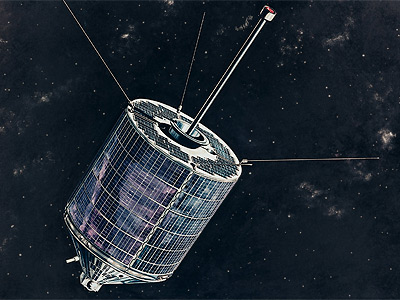
Azur [NASA]
The magnetically aligned spacecraft Azur, a.k.a. GRS A (German Research Satellite), launched into a near-polar orbit in November of 1969, was a product of a joint effort by NASA-GSFC and the German Bundesministerium für Wissenschaftliche Forschung (BMWF) and had as its primary purpose the acquisition of terrestrial radiation belt data. Specifically, the scientific mission of the spacecraft was as follows:
- to scan the energy spectra of inner zone protons and electrons,
- to measure the fluxes of electrons of energy greater than 40 keV.that are parallel, antiparallel, and perpendicular to the magnetic lines of force over the auroral zone and to measure associated optical emission, and
- to record solar protons on alert.
Azur carried seven instruments:
- Fluxgate Magnetometer
- Proton-Alpha Telescope
- Proton Telescope
- Proton-Electron Detector
- Geiger Tube Electron Counters
- Geiger Mueller Counters
- Auroral Photometers
After about 24 hours in orbit, a command system instability developed and persisted intermittently throughout the flight. The tape recorder failed on 8 December 1969. Prior to this failure, the German project office estimated that 85 - 90% Solar Physics operating normally until the spacecraft telemetry system malfunctioned in on 29 June 1970 after seven month on orbit.
| Nation: | Germany |
|---|---|
| Type / Application: | Research, ionosphere |
| Operator: | BMWF, NASA |
| Contractors: | Gesellschaft für Weltraumforschung mbH, MBB (prime) |
| Equipment: | see above |
| Configuration: | |
| Propulsion: | |
| Power: | Solar cells, batteries |
| Lifetime: | 1 years (design); 7 months (achieved) |
| Mass: | 71 kg |
| Orbit: | 388 km × 3142 km, 102.97° |
| Satellite | COSPAR | Date | LS | Launch Vehicle | Remarks | |
|---|---|---|---|---|---|---|
| Azur (GRS 1) | 1969-097A | 08.11.1969 | Va SLC-5 | Scout-B |