Thank you very much for visiting Gunter's Space Page. I hope that this site is useful and informative for you.
If you appreciate the information provided on this site, please consider supporting my work by making a simple and secure donation via PayPal. Please help to run the website and keep everything free of charge. Thank you very much.
Aquarius / SAC D (ESSP 6)
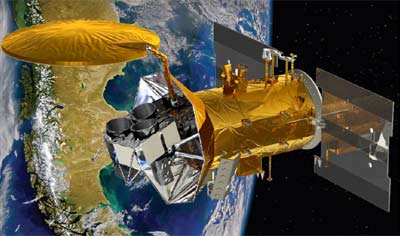
Aquarius / SAC D [NASA]
Aquarius / SAC-D is a focused satellite mission to measure global Sea Surface Salinity (SSS). Scientific progress is limited because conventional in situ SSS sampling is too sparse to give the global view of salinity variability that only a satellite can provide. Aquarius will resolve missing physical processes that link the water cycle, the climate, and the ocean.
Aquarius was launched in 2011 on a Delta-7320-10C booster. Aquarius / SAC-D is a space mission developed by NASA and the Space Agency of Argentina (Comisión Nacional de Actividades Espaciales, CONAE). CONAE provides the spacecraft bus while NASA provides the L-band Radiometer / Scatterometer Instrument.
The satellite failed in June 2015 after a 4 year mission.
| Nation: | USA, Argentina |
|---|---|
| Type / Application: | Earth Science (Ocean salinity) |
| Operator: | NASA, CONAE |
| Contractors: | NASA (payload), INVAP (bus) |
| Equipment: | L-band Radiometer / Scatterometer |
| Configuration: | |
| Propulsion: | |
| Power: | 2 deployable solar arrays (1362 W), batteries |
| Lifetime: | 3 years (minimum); 5 years (design); 4 years (achieved) |
| Mass: | 1350 kg |
| Orbit: | 657 km × 657 km; 98° |
| Satellite | COSPAR | Date | LS | Launch Vehicle | Remarks | |
|---|---|---|---|---|---|---|
| Aquarius / SAC D (ESSP 6) | 2011-024A | 10.06.2011 | Va SLC-2W | Delta-7320-10C |
References:
- CONAE: SAC-D/Aquarius
- INVAP: SAC-D/Aquarius
Further ESSP missions:
|
Further SAC missions:
|