Thank you very much for visiting Gunter's Space Page. I hope that this site is useful and informative for you.
If you appreciate the information provided on this site, please consider supporting my work by making a simple and secure donation via PayPal. Please help to run the website and keep everything free of charge. Thank you very much.
Neptune
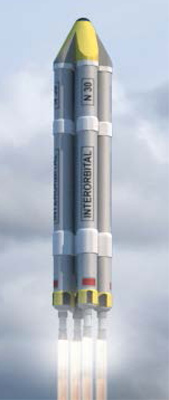 Neptune-5 (CPM 1 based) |
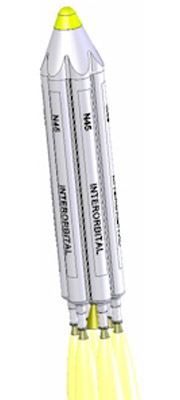 Neptune-7 (CPM 1 based) |
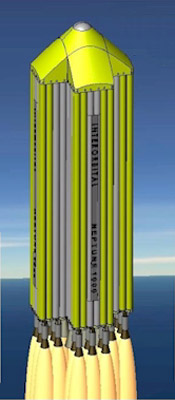 Neptune-36 (CPM 2 based) |
InterOrbital Systems plans a series of small modular launch vehicles called Neptune consisting of clusters of simple pressure-fed rocket modules.
The IOS modular rocket system is an evolved version of a similar system developed by OTRAG in the 1970's. Lutz Kayser, the former head of the OTRAG team, is a primary consultant on the IOS project.
Each member of the Neptune Modular Series of launch vehicles is assembled from multiple Common Propulsion Modules (CPMs). Payload capacity can be varied by increasing or decreasing the number of CPMs. A single CPM will be flown as a test vehicle and later as a sounding rocket.
Each Common Propulsion Module 1.0 is composed of two tandem propellant tanks and a single throttleable, ablatively-cooled rocket engine. Depending on the configuration, the modules can operate in either blowdown or pressurant tank-fed modes. The capacity of the propellant tanks is regulated by varying their lengths. Construction costs are kept low by utilizing many off-the-shelf components. All CPM parts are interchangeable and mass-producible.
The Common Propulsion Module 2.0 is composed of four parallel propellant tanks.
A single fixed, throttleable, low-thrust, liquid rocket engine powers each CPM. When the CPMs are clustered in multiples of three or four per stage, differential throttling of opposing rocket engines provides pitch, yaw and roll control. Stand-alone CPMs will be steered by four small gimbaled vernier rocket engines. Storable, high-density white fuming nitric acid (WFNA) and turpentine/furfuryl alcohol are the CPM’s primary propellants. These low-cost, storable, environmentally friendly propellants provide reliable, efficient, hypergolic ignition.
The Neptune-5 (formely Neptune-30) is a three stage (parallel staged) micro-satellite launch vehicle capable of launching 30 kg payload into polar low-earth orbit. It is composed of 5 Common Propulsion Modules and a solid spin-stabilized satellite kick-stage. The engine count breaks down to 4 booster engines, 1 stage-2 engine, and 1 stage-3 engine (a total of 6 engines).
The Neptune-7 (formely Neptune-45) is a three stage (parallel staged) micro-satellite launch vehicle capable of launching 45 kg payload into polar low-earth orbit. It is composed of 7 Common Propulsion Modules and a solid spin-stabilized or a liquid guided satellite kick-stage. The engine count breaks down to 6 booster engines, 1 stage two engine, and 1 stage three motor or engine (a total of 8 engines).
The Neptune-9 (formely Neptune-70) is a three stage (parallel staged) micro-satellite launch vehicle capable of launching 70 kg payload into polar low-earth orbit. It is composed of 9 Common Propulsion Modules and a solid spin-stabilized or a liquid guided satellite kick-stage. The engine count breaks down to 6 booster engines, 2 stage two engines, 1 stage three engine, and 1 stage four motor or engine (a total of 10 engines).
The Neptune-36 (formerly Neptune-1000) is a four stage (parallel staged), medium-lift launch vehicle capable of placing a 1000 kg payload into polar low-earth orbit or accelerating a 190 kg payload to Earth-escape velocity. The rocket is composed of 33 Common Propulsion Modules. The engine count breaks down to 24 booster engines, 6 stage two engines, 2 stage three engines, and 1 stage four engine.
Flights of the CPM and the Neptune series have been announced for several years to be imminent, with little visible progress happening. The GPRE-7.5KNTA main engine of the CPM was first test fired in October 2012. IOS currently claims to be able to launch an orbital mission in th 4th quarter of 2016.
| Version | Stage 1 | Stage 2 | Stage 3 | Stage 4 |
|---|---|---|---|---|
| Neptune-1 (N1) | CPM 2.0 / GPRE-7.5KNTA | ? | ? | - |
| Neptune-3 (N3) | 2 × CPM 2.0 / GPRE-7.5KNTA | CPM 2.0 / GPRE-7.5KNTA | Minerva-1 | Minerva-1 |
| Neptune-5 (N5) (ex Neptune-30) | 4 × CPM / GPRE-7.5KNTA | CPM / GPRE-7.5KNTA | Kick stage | - |
| Neptune-7 (N7) (ex Neptune-45) | 6 × CPM / GPRE-7.5KNTA | CPM / GPRE-7.5KNTA | Kick stage | - |
| Neptune-9 (N9) (ex Neptune-70) | 6 × CPM / GPRE-7.5KNTA | 2 × CPM / GPRE-7.5KNTA | CPM / GPRE-7.5KNTA | Kick stage |
| Neptune-36 (N36) (ex Neptune-1000) | 24 × CPM / GPRE-7.5KNTA | 6 × CPM / GPRE-7.5KNTA | 2 × CPM / GPRE-7.5KNTA | CPM / GPRE-7.5KNTA |
| Performance (kg) | LEO | LPEO | SSO | GTO | GEO | MolO | IP |
|---|---|---|---|---|---|---|---|
| Neptune-1 (N1) | 6 | - | - | - | - | - | |
| Neptune-3 (N3) | - | - | - | - | - | ||
| Neptune-5 (N5) | 30 | - | - | - | - | - | - |
| Neptune-7 (N7) | 45 | ||||||
| Neptune-9 (N9) | 70 | ||||||
| Neptune-36 (N36) | 1000 | 190 |
No: TNo: Serial Type Date LS Payload
none


* = suborbital
References:
- InterOrbital Systems: Neptune website